Progressive Betting vs Flat Ratios in Dice Games

Progressive Betting vs Flat Ratios in Dice Games
When playing dice games, choosing the right betting strategy can shape your experience and impact your bankroll. The two main approaches are progressive betting and flat betting:
-
Progressive Betting: Adjusts your bet size based on previous outcomes. Popular methods include:
- Martingale: Double your bet after each loss.
- Paroli: Increase bets after wins to capitalize on streaks.
- Fibonacci: Follow the Fibonacci sequence for bet adjustments.
- Risk: High; requires larger bankrolls and can lead to quick losses during bad streaks.
-
Flat Betting: Keeps your bet size constant across all rounds.
- Advantages: Simpler, lower risk, and better for longer sessions.
- Risk: Low; ideal for smaller bankrolls and steady gameplay.
Both strategies operate under the same house edge (typically ~1%), meaning neither can guarantee long-term profit. The choice depends on your risk tolerance, bankroll size, and session goals.
Quick Comparison
| Strategy | Pros | Cons | Best For | Risk Level |
|---|---|---|---|---|
| Progressive Betting | Potential for faster recovery; can maximize streaks | High risk of large losses; bankroll-intensive | Short, high-intensity sessions | High |
| Flat Betting | Consistent and predictable; avoids emotional decisions | Slower gains; less exciting | Extended sessions; casual play | Low |
Your decision should align with how much risk you're comfortable taking and how you want to manage your funds. Tools like auto-betting on platforms such as Windice can help you test these strategies efficiently.
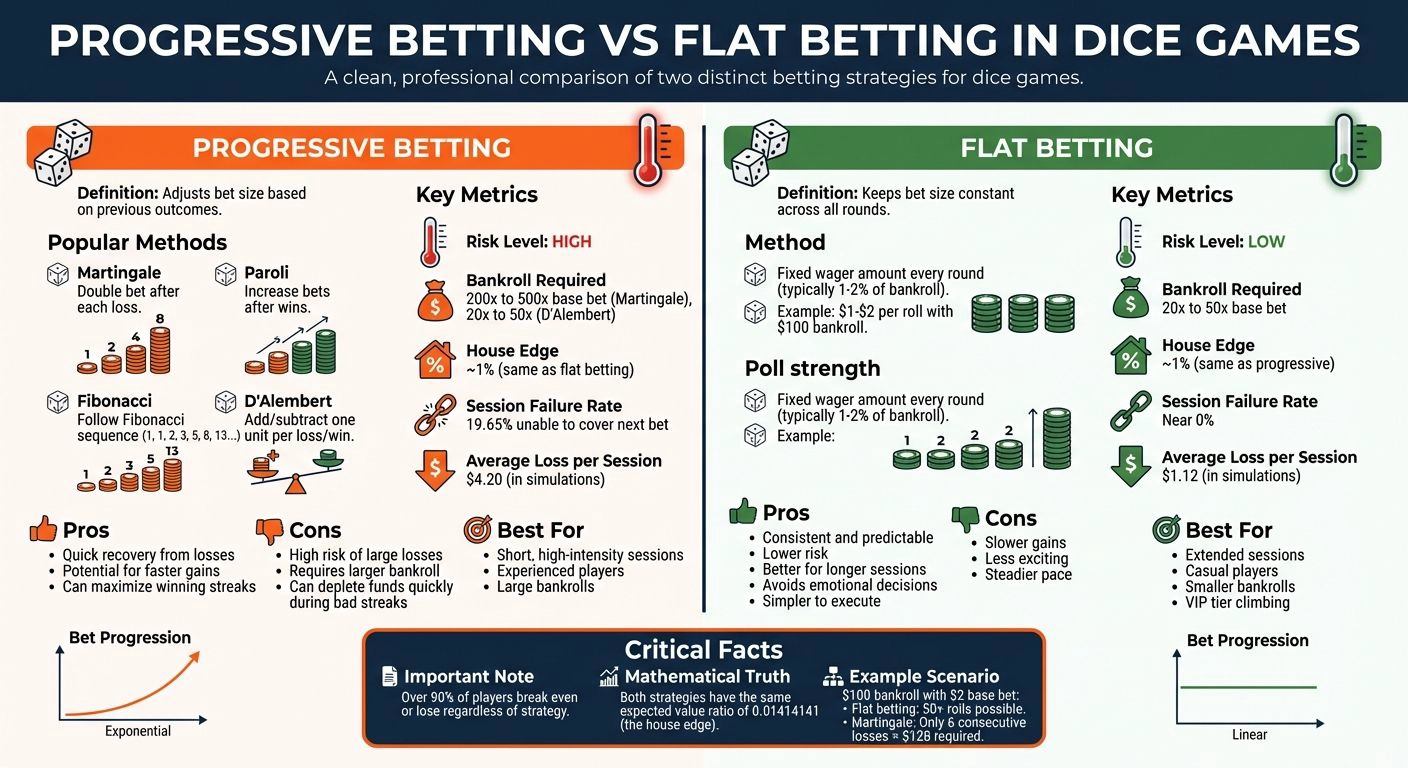
Progressive vs Flat Betting Strategies in Dice Games Comparison Chart
Winning at Craps with Betting Progressions - Some Comparisons
What Is Progressive Betting?
Progressive betting is a strategy where you adjust your bet size based on the outcomes of previous rounds. Instead of sticking with a fixed wager, you follow specific rules to increase or decrease your bets depending on wins or losses.
There are two main types of progressive betting systems. Negative progression strategies, like the Martingale system, involve increasing your bet after a loss. The idea is to recover previous losses with a single win. On the other hand, positive progression strategies take the opposite approach. These systems, such as the Paroli method, increase bets after a win to capitalize on winning streaks while limiting losses. For example, the Paroli system doubles your bet after each win, up to three consecutive wins, before resetting.
In dice games, the most well-known progressive betting systems include:
- Martingale: Double your bet after every loss.
- D'Alembert: Add one unit to your bet after a loss and subtract one unit after a win.
- Fibonacci: Follow the Fibonacci sequence (1, 1, 2, 3, 5, 8, 13...) by moving forward in the sequence after a loss and stepping back two places after a win.
Each system comes with its own level of risk. For instance, Martingale is highly aggressive and requires a bankroll of 200 to 500 times your base bet, while D'Alembert is more conservative, needing only 20 to 50 times your base bet. While these systems are grounded in mathematical principles, understanding their risk profiles is crucial.
Marcus explains it this way:
The Martingale system is popular for its simplicity: double your bet after every loss until a win recovers previous losses and adds the original stake.
However, it’s important to note that no progressive betting system can eliminate the house edge. For example, a Martingale sequence starting at $2.00 could require a $256.00 bet after eight consecutive losses. If you hit a table limit or run out of funds before recovering, the strategy fails. That's why it’s essential to carefully weigh the risks and rewards of each method before committing real money.
What Is Flat Betting?
Flat betting is a straightforward strategy where you place the same wager amount for every round, no matter if you win, lose, or tie. In dice games - especially in crypto dice games - this means choosing a fixed bet amount and a specific probability (like betting "over 50") and sticking to that setup for every roll. Since the bet size stays constant, there’s no need to track patterns or adjust your stake mid-game. This consistency sets flat betting apart from more complex progressive systems.
Unlike progressive betting, which involves changing your wager size based on previous outcomes, flat betting keeps things steady. Its simplicity has earned it the nickname "cruise control" of betting. Another advantage? Fixed stakes can help you avoid "tilt" - that emotional urge to chase losses by making bigger and riskier bets. This makes flat betting a great choice for beginners or players with smaller bankrolls who want to enjoy longer gameplay without taking on extra risk.
Paul Trevor, a writer at Outplayed, explains:
Flat betting focuses on probability over lucky streaks to yield long-term results.
In crypto dice games, many experts suggest betting between 1% and 2% of your total bankroll per roll. For example, if you have a $100 bankroll, flat bets of $1.00 to $2.00 per roll can give you enough room to handle the natural ups and downs of the game. Mastering this disciplined approach is an essential step toward managing risk effectively in dice games.
How These Strategies Differ in Dice Games
Dice games bring the distinctions between progressive and flat betting strategies into sharp focus. With autobet features processing bets at speeds of up to 3 rolls per second, the rapid gameplay amplifies the effects of each approach on your bankroll.
One key difference lies in risk exposure. Progressive systems, especially negative progressions like Martingale, carry escalating risks. A losing streak can snowball quickly, potentially draining your entire balance in a matter of minutes. On the other hand, flat betting offers a more stable approach, keeping risk constant and predictable with each roll. This steady risk aligns directly with the house edge. For example, during a losing streak, a Martingale strategy might require exponentially larger bets, whereas flat betting avoids such dramatic increases.
Bankroll requirements also vary significantly. Aggressive progressive systems like Martingale demand a bankroll of 200x to 500x your base bet to withstand even short sessions. More conservative systems, such as D'Alembert, typically require 20x to 50x your base bet. Flat betting, however, is more forgiving. You can start with as little as 20x to 50x your base bet and still enjoy extended gameplay. For instance, with a $100 bankroll and $1.00 flat bets per roll, you can endure natural variance comfortably. But with a $2.00 base bet under Martingale, just a few bad rolls could leave you empty-handed.
The pace of dice games further highlights these differences. Progressive systems can quickly hit table limits or deplete your funds during a cold streak due to their exponential nature. Flat betting, by contrast, progresses at a steady, linear rate, making it a better fit for longer grinding sessions or meeting wagering requirements. Progressive systems, meanwhile, are better suited to short, high-intensity play with specific profit goals.
Most crypto dice games operate with a house edge of about 1%. Interestingly, over time, more than 90% of players either break even or lose, regardless of the strategy they use. The real difference between these approaches isn’t in the expected returns but in how they manage risk, bankroll, and the psychological demands of fast-paced gameplay. Recognizing these practical differences is essential for understanding the math behind each strategy.
Pros and Cons of Each Strategy
Each betting strategy comes with its own set of trade-offs, offering different benefits and challenges depending on your goals and approach. Progressive systems, for instance, can lead to quicker recovery from losses and potentially higher short-term returns by adjusting stakes after each outcome. However, these strategies demand larger bankrolls and a higher tolerance for risk. A single losing streak can wipe out funds quickly, especially with negative progression systems like the Martingale.
On the other hand, flat betting keeps things simple by maintaining a consistent wager size throughout each session. This approach is more stable and less risky. While it avoids the dramatic swings of progressive systems, it also means slower, steadier gains. Flat betting is particularly well-suited to casual players or those working with a smaller budget. For example, with a $100 bankroll, you could comfortably flat bet $2.00 per roll for a longer session. Meanwhile, the same $100 would barely support a $2.00 Martingale base bet - just six consecutive losses would cost you $128.
Side-by-Side Comparison
| Strategy | Advantages | Disadvantages | Best Use Cases in Dice | Risk Level |
|---|---|---|---|---|
| Progressive Betting | Quick recovery from losses; higher short-term returns | High risk of large losses; requires a larger bankroll | High-stakes games; experienced players | High |
| Flat Betting | Low risk; consistent bankroll management | Slower gains; steadier pace | Low-stakes games; casual players | Low |
It’s important to note that no system can eliminate the house edge. Marcus explains:
"Regardless of which system you choose, your expected value remains negative due to the house edge".
The real question isn’t about which strategy wins more often - it’s about which one aligns best with your bankroll, risk tolerance, and play style. Understanding these trade-offs lays the groundwork for exploring the math behind each approach.
The Math Behind Both Strategies
When you break it down, the math behind betting strategies reveals a simple truth: no system can erase the house edge. Every dice roll is an independent event. What happened in the past has no bearing on what happens next - a concept often misunderstood due to the "gambler's fallacy". Whether you stick to a $5.00 flat bet or double your wager after each loss, the probabilities stay the same. This perspective helps explain why changing your bet size doesn’t reduce the inherent risk of any single roll.
The formula for Expected Value (EV) is straightforward: (Win Probability × Win Amount) – (Loss Probability × Loss Amount). For example, with a house edge of 1.364%, a $100 bet results in an expected loss of about $1.36, no matter how you structure your bets. Michael Shackleford, sums it up perfectly:
In the long run no betting system can withstand the test of time. The longer you play, the ratio of money lost to money bet will get closer to the expectation for that game.
Flat betting offers a predictable outcome: the total amount wagered directly correlates with the expected loss. For instance, if you bet $10.00 per roll over 100 rounds, you’re wagering $1,000.00 in total. Based on the house edge, you can expect to lose $13.64. Progressive systems like Martingale don’t change this math. Instead, they shift the outcomes around, increasing variability.
Simulations back this up. In 1,000,000 sessions, flat bettors averaged a $1.12 loss per session, while Martingale users lost $4.20 on average. However, Martingale players ran into a significant issue: 19.65% of sessions ended with them unable to cover their next bet, resulting in substantial losses. Despite these differences, the ratio of money lost to money wagered for both groups was the same: 0.01414141 - the exact house edge. As Richard A. Epstein once observed:
Betting systems constitute one of the oldest delusions of gambling history. Betting systems votaries are spiritually akin to the proponents of perpetual motion machines.
Ultimately, progressive systems might give the illusion of control by varying bet sizes, but the math doesn’t lie. Both flat and progressive strategies face the same negative expected value, just distributed differently over time.
Using These Strategies on Windice

Windice's dice game offers an auto-betting engine that takes the hassle out of testing strategies like Martingale, Fibonacci, or flat betting. All you need to do is set your base bet, pick your progression method, and let the system handle the rest. This automation eliminates manual errors and works seamlessly with Windice's transparent, provably fair system.
The platform ensures fairness with a system that uses a server seed, client seed, and nonce to verify the randomness of every outcome. With a ~1% house edge, this setup guarantees that both progressive and flat betting strategies operate under consistent and verifiable conditions.
Instant payouts further enhance bankroll management. Flat bettors can withdraw steady profits, while those using progressive strategies like Paroli can secure their winnings before a losing streak hits.
To manage risk effectively, Windice provides stop-loss and profit-taking settings. A good rule of thumb is to keep your base bet between 1–2% of your bankroll. For example, if you have $500 to play with, your bets should stay at or below $10.00.
Windice also fosters a sense of community with on-site chat and forums. Here, players share strategies, custom scripts, and real-time tips. Advanced users often contribute modified betting sequences and insights, making it easier to refine both progressive and flat betting approaches based on collective knowledge.
Choosing the Right Strategy for You
When deciding on a betting strategy, your risk tolerance should guide your choice. If you prefer steady, predictable gameplay without dramatic swings in your bankroll, strategies like flat betting or conservative progressions, such as D'Alembert, are solid options. These approaches help you control variance while keeping risk in check. However, if you’re comfortable with high volatility and have a larger bankroll to back it up, aggressive strategies like Martingale or Labouchere might appeal to you. These systems can help recover losses quickly but come with the danger of depleting your funds during prolonged losing streaks.
Another factor to weigh is your session duration. If you’re planning an extended session - perhaps to climb Windice's VIP tiers or meet wagering requirements - flat betting is ideal. It allows for more playtime without the risk of exponentially increasing bets. On the flip side, for shorter, more intense sessions, positive progressions like Paroli can help you take advantage of winning streaks while keeping potential losses in check.
Your bankroll size is equally important. For instance, with a $500 bankroll, a base bet of $5.00–$10.00 works well for flat or low-risk strategies. Aggressive systems, however, require a much larger reserve. If your bankroll is limited, sticking to conservative approaches or positive progressions - typically requiring only 20× to 50× your base bet - is a safer path.
Windice also offers tools to help you stick to your plan. Windice's auto-bet presets make it easier to execute strategies without manual errors. You can set stop-loss and profit limits to avoid emotional decisions and fine-tune the auto-betting settings to align with your chosen progression.
"Strategy isn't about 'beating the house' but about smoothing variance, stretching sessions, and knowing when to push risk." – Bitrollers Guide
Lastly, keep in mind that no strategy can eliminate the house edge. Over time, the house edge - typically around 1–2% - will erode any potential gains. Historical data shows that over 90% of players eventually break even or lose. The key is to manage variance, enjoy the game, and play responsibly within your limits.
FAQs
What are the risks of using the Martingale strategy compared to the Paroli in dice games?
The Martingale and Paroli strategies take opposite approaches when it comes to managing risk and reward in dice games. Let’s break them down.
The Martingale strategy is all about doubling your bet after every loss. The idea is simple: when you eventually win, you recover all previous losses and make a small profit. While this sounds appealing, it comes with a serious downside. A long losing streak can quickly escalate your bets to massive amounts, risking your entire bankroll or running into table limits before you can recover.
In contrast, the Paroli strategy works on a positive progression system. Here, you only increase your bet after a win, not a loss. This method keeps your losses in check during a bad streak while letting you take advantage of a winning streak. By capping the progression after a certain number of wins, the Paroli system keeps things more controlled, reducing the likelihood of significant losses.
To put it simply, the Martingale strategy is aggressive and risky, while the Paroli strategy offers a steadier, more cautious path. If you’re looking to avoid major financial swings, the Paroli system might be the better fit.
Why is flat betting often preferred for longer gaming sessions?
Flat betting is a popular choice for players who want to enjoy longer gaming sessions while keeping their bankroll in check. By sticking to the same wager amount for each round, this strategy helps avoid the steep losses that can come with riskier approaches like progressive betting.
For those who value extended playtime, flat betting offers a safer way to enjoy the game. While it might not deliver quick, massive wins, it provides a steady and consistent experience, reducing the chances of dramatic financial ups and downs.
What kind of bankroll do I need for progressive betting strategies in dice games?
To make the most of progressive betting strategies in dice games, having a solid bankroll is crucial. These tactics, like the Martingale system, often involve increasing your wager after each loss. For instance, if you start with a $1 bet and double it after every loss, you’d need more than $1,000 to cover just 10 consecutive losses.
A smart way to manage your risk is by betting only a small portion of your total funds - usually around 1-5% per wager. This method helps safeguard your bankroll from being drained too quickly while giving you the chance to play responsibly. The goal is to ensure your funds can handle the progression without running out before you recover.