Martingale Strategy vs. Probability Calculators for Dice

Martingale Strategy vs. Probability Calculators for Dice
Martingale and probability calculators are two distinct approaches for dice gaming. Martingale involves doubling your bet after a loss to recover losses and secure a small profit. It’s simple but risky, as losing streaks can escalate bets exponentially, draining your bankroll. Probability calculators, on the other hand, use math to estimate risks, calculate bankroll needs, and predict outcomes, helping you plan and manage long-term gameplay.
Key Takeaways:
- Martingale: High session win rate but risky due to exponential bet growth. Requires a large bankroll to survive losing streaks.
- Probability Calculators: Analyze risks, calculate probabilities, and help manage bankroll effectively. They don’t predict outcomes but provide clarity on potential risks.
Quick Comparison
| Feature | Martingale Strategy | Probability Calculators |
|---|---|---|
| Function | Recover losses by doubling bets | Analyze risks and calculate probabilities |
| Risk Level | High (exponential loss growth) | Low (informational, no direct risk) |
| Bankroll Needs | Very high | Calculated based on risk tolerance |
| Win Probability | High per session | Estimates success/failure probabilities |
| House Edge Impact | None | None (confirms house edge mathematically) |
| Best Use Case | Short-term wins | Long-term planning and risk management |
Neither approach removes the house edge, but combining them can help balance short-term gains with long-term risk management. Use probability calculators to assess risks before diving into Martingale sessions.
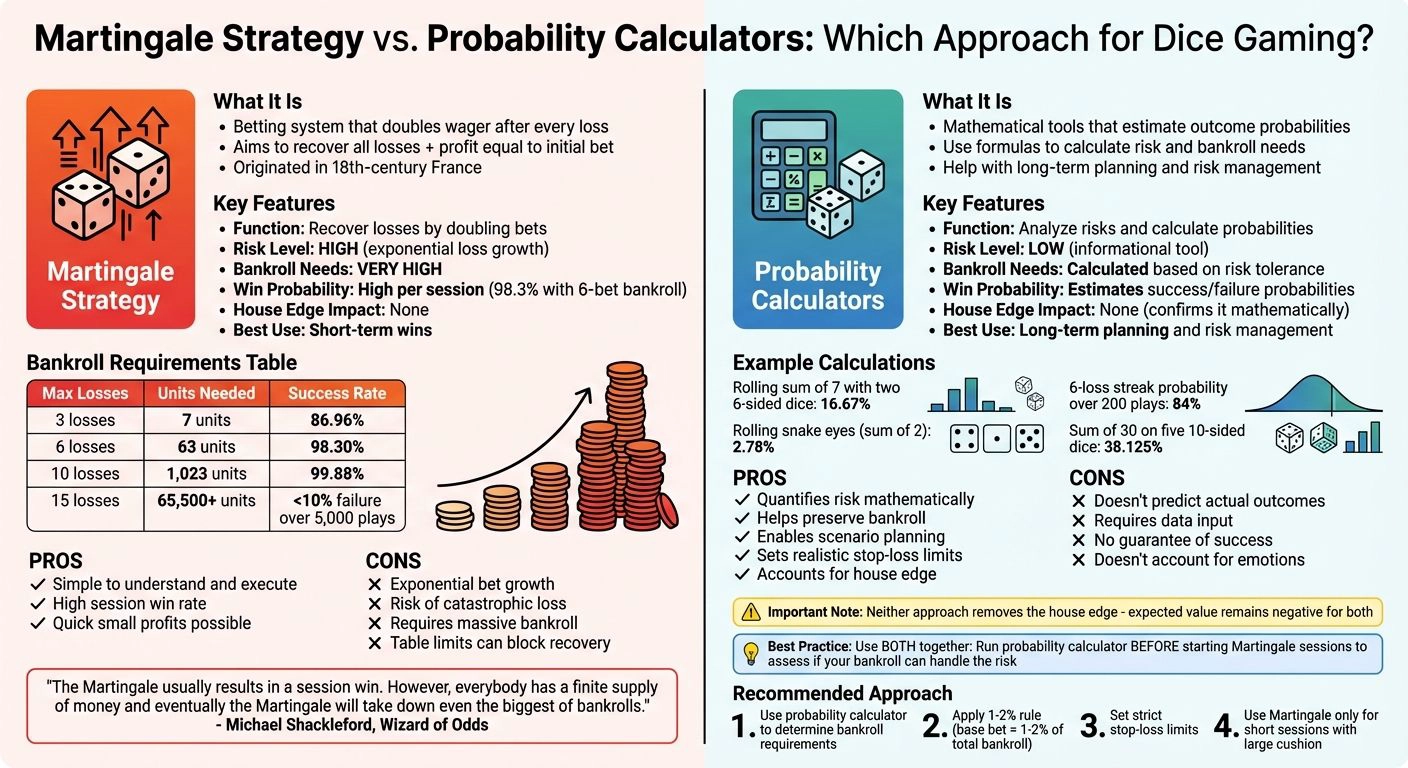
Martingale Strategy vs Probability Calculators for Dice Gaming Comparison
How to Use Math To Beat Roulette - The Martingale Strategy
What is the Martingale Strategy?
The Martingale strategy is a betting system where you double your wager after every loss. This approach, which traces its roots back to 18th-century France and is often linked to John H. Martingale, a casino owner in London, is based on the idea that your eventual win will recoup all previous losses and leave you with a profit equal to your initial bet.
In dice games, the Martingale strategy is commonly used for even-money bets, like the Pass Line or Don't Pass Line bets in Craps. After a win, the bet resets back to the original amount. However, the system assumes that a win is bound to happen eventually, even though the odds of winning these bets aren’t a true 50/50. For instance, the probability of a Pass Bet winning in Craps is about 49.29%. And thanks to the house edge, the expected value of this strategy remains negative over time. This sets the stage for understanding both the appeal and the drawbacks of using the Martingale in dice games.
Key Features of the Martingale Strategy
One of the reasons the Martingale strategy is so appealing is its straightforward nature. For example, a player with a bankroll of 63 units (enough to weather six consecutive losses) can expect to walk away with a winning session roughly 98.30% of the time. However, the method comes with a steep requirement: a large bankroll. To reduce the chance of losing everything over 5,000 plays to less than 10%, you’d need enough funds to handle 15 consecutive losses - amounting to over 65,500 times your initial bet.
Here’s a look at how quickly the required bankroll grows:
| Maximum Losing Bets | Bankroll Units Required | Probability of Success (Craps Pass Bet) |
|---|---|---|
| 3 | 7 | 86.96% |
| 4 | 15 | 93.38% |
| 5 | 31 | 96.64% |
| 6 | 63 | 98.30% |
| 7 | 127 | 99.13% |
| 8 | 255 | 99.56% |
| 10 | 1,023 | 99.88% |
Understanding these numbers is essential, especially when comparing the Martingale system to other tools, like probability calculators. It’s also important to keep table limits in mind, as they can prevent you from placing the necessary bets to recover losses.
Risks of the Martingale Strategy
While the Martingale system may seem simple and promising, it comes with serious risks. The most obvious danger is how quickly your bets escalate. A losing streak of just 10 bets in a row requires a total bankroll equivalent to 1,023 times your initial wager. To put it into perspective, the chance of losing six bets in a row on a single-zero roulette wheel is about 1.8% for any single series of bets. However, over the course of 200 plays, the likelihood of hitting such a streak jumps to approximately 84%.
"The siren's call of the Martingale has fooled many gamblers as it usually results in a session win. However, everybody has a finite supply of money and eventually the Martingale will take down even the biggest of bankrolls."
- Michael Shackleford, Founder, Wizard of Odds
The reality is that no bankroll is infinite, and table limits add another layer of restriction. The system’s reliance on continuous doubling means that one long losing streak can deplete your funds entirely, wiping out any previous gains. Ultimately, this leads to an expected value of zero. These risks will be explored further when comparing the Martingale strategy to more precise probability-based approaches later in this article.
What are Probability Calculators for Dice?
Probability calculators are tools designed to estimate the chances of specific outcomes in dice games. Unlike betting systems that focus on wagering strategies, these calculators rely on mathematical formulas to figure out the ratio of favorable outcomes to all possible outcomes. They work with various types of dice, ranging from the standard 6-sided dice to polyhedral ones like 4-sided (tetrahedron), 8-sided (octahedron), 10-sided (decahedron), 12-sided (dodecahedron), and even 20-sided (icosahedron) dice.
These calculators go beyond intuition, which often leads players astray by failing to account for the uneven probabilities of dice rolls. For example, when rolling two 6-sided dice, there are 36 possible outcomes. A sum of 7 is much more common than a sum of 2 because there are six combinations that result in 7 (1+6, 2+5, 3+4, 4+3, 5+2, 6+1), while only one combination gives a sum of 2 (1+1). This makes the probability of rolling a 7 16.67%, compared to just 2.78% for rolling "snake eyes" (a sum of 2). Up next, let’s explore how these calculators operate and the advantages they bring to the table.
How Probability Calculators Work
These calculators use precise mathematical formulas to provide theoretical odds with complete accuracy. They need basic inputs, like the type and number of dice being rolled, and then calculate probabilities by systematically counting all possible combinations.
They can handle various types of probability calculations. For single outcomes, the formula used is $P = (1/s)^n$, where s is the number of sides on the dice, and n is the number of dice rolled. When it comes to sum probabilities, the calculators account for all combinations that can produce the same total. For instance, rolling three 10-sided dice gives a 2% chance of achieving a sum of at least 27. They can even calculate binomial probabilities, such as the odds of rolling exactly two 9s out of seven 12-sided dice.
On crypto dice platforms like Windice, these tools assist players in setting parameters for automated strategies. Players can calculate the "Odds of a losing streak" to help manage their bankroll and avoid overextending. Additionally, these calculators allow for "what-if" scenario planning, enabling players to compare probabilities across different betting options to find the most favorable choice. On platforms like Windice, they’re invaluable for fine-tuning risk management and betting strategies.
Benefits of Probability Calculators
By replacing guesswork with mathematical precision, probability calculators offer clear advantages for strategic betting. They help bridge the gap between perception and reality, which can significantly influence decision-making.
One major benefit is their ability to help players analyze the house edge before placing bets. By calculating the expected return for each outcome and summing the results, players can see exactly how the house advantage impacts their potential winnings. This approach contrasts with betting systems like Martingale, which focus on recovering losses without altering the odds or reducing the house edge.
Another advantage is their versatility in different game scenarios. Players can quickly compare probabilities, such as discovering that rolling a sum of 30 on five 10-sided dice (38.125% probability) is more likely than a sum of 28 on five 12-sided dice (30.72% probability). These tools also simplify complex calculations using the "rule of 1", which states that the total probability of all outcomes equals 1. This allows players to find the probability of "not" hitting a specific result by simply subtracting the probability of hitting it from 1, instead of calculating every possible winning combination.
Martingale Strategy vs. Probability Calculators: Side-by-Side Comparison
Let’s break down the differences between the Martingale strategy and probability calculators in dice gaming. While the Martingale strategy focuses on doubling your bet after each loss to recover previous losses and secure a profit equal to your initial wager, probability calculators are tools designed to analyze, predict, and quantify risks before you even place a bet.
At their core, these two approaches couldn’t be more different. The Martingale strategy is reactive - it follows a strict "double-up" rule aimed at achieving a specific win per session, typically equal to your starting bet. On the other hand, probability calculators take a proactive stance, helping you measure the "Maximum Loss" and assess how far your bankroll can stretch before running out. As Kim Birch from MartingaleCalc.com aptly puts it, "the growth of stake size is exponential, while the bankroll is finite. This structural imbalance dominates outcomes and guarantees a non-zero probability of failure".
It’s important to note that neither method removes the house edge. Whether you’re doubling bets or crunching numbers, the expected value remains negative. However, understanding these differences can help Windice players align their strategy with their risk tolerance and gaming preferences. Here’s a quick comparison:
Comparison Table
| Feature | Martingale Strategy | Probability Calculators |
|---|---|---|
| Primary Function | Doubling bets after losses to recover funds | Modeling stake increases and assessing risks |
| Risk Level | High: Exponential growth can lead to major loss | Low: Helps plan and mitigate risks |
| Bankroll Needs | High: Requires 2^n - 1 units for n bets | Calculates exact bankroll for given steps |
| Win Probability | High per session (e.g., 98.3% for 6-bet runs) | Estimates odds of success and risk of failure |
| Session Success Rate | Very high (often ends in a win) | N/A: Focused on decision-making, not execution |
| Long-term Expected Value | Negative: The house edge remains unchanged | Negative: Confirms house edge mathematically |
| Primary Goal | Recover losses in a single win | Quantify risks and model potential outcomes |
Before jumping into a Martingale session on Windice, it’s wise to use a probability calculator first. This tool helps you figure out the "deepest progression step" your bankroll can handle, reducing the risk of unexpected insolvency. For example, if you want less than a 10% chance of failing over 5,000 plays, your bankroll must be large enough to cover 15 consecutive losses - over 65,500 times your original bet.
Pros and Cons of Each Approach
When it comes to dice gaming strategies on Windice, Martingale and probability calculators each bring their own strengths and limitations. Understanding these can help you make an informed decision about which approach suits your style and goals.
The Martingale strategy is appealing for its straightforward nature - just double your bet after every loss. This simplicity often leads to a high session win rate. However, it comes with a major downside: the exponential growth of bets can quickly drain your bankroll, especially if you hit a long losing streak. Plus, it doesn’t alter the house edge, meaning the expected value remains negative.
On the other hand, probability calculators take a more measured approach. These tools help you assess risk, forecast potential losses, and plan your bankroll effectively. They’re particularly useful for setting stop-loss limits and managing long-term gameplay on Windice. That said, they won’t predict actual outcomes, guarantee success, or account for emotional decision-making.
Here’s a quick side-by-side comparison of the two methods:
Pros and Cons Comparison Table
| Feature | Martingale Strategy | Probability Calculators |
|---|---|---|
| Primary Advantage | Easy to use; high session win rate | Helps quantify risk and preserve bankroll |
| Ease of Use | Simple; just double after a loss | Moderate; requires inputting data |
| Risk Level | Very high; potential for catastrophic loss | Low; purely an informational tool |
| Bankroll Requirements | Huge (e.g., 65,500× original bet for <10% failure across 5,000 plays) | Helps calculate exact needs before starting |
| House Edge Impact | No effect on house edge | Accounts for house edge in calculations |
| Best Use Case | Short-term wins | Long-term risk management and planning |
| Main Drawback | Exponential bet growth can lead to bankruptcy | Doesn’t predict outcomes or guarantee success |
Both approaches have their place, depending on your goals and risk tolerance. Whether you prioritize short-term wins or long-term stability, knowing the pros and cons can make all the difference.
When to Use Martingale vs. Probability Calculators on Windice Dice

Deciding whether to use Martingale or probability calculators on Windice dice comes down to factors like your bankroll size, risk tolerance, and overall goals.
Martingale is ideal for short sessions, especially if you have a large bankroll and are aiming for quick, small, consistent profits. To use this strategy effectively, you’ll need a significant financial cushion - around 200–500 times your base bet. For example, if your base bet is $1, your bankroll should be between $200 and $500. Stick to the 1-2% rule: your base bet should never exceed 1-2% of your total bankroll. This approach gives you enough room to weather losing streaks without depleting your funds. Understanding how Martingale aligns with your play style on Windice is key before diving in.
On the other hand, probability calculators are better suited for conservative, long-term strategies. These tools help you assess risks before placing any bets, making them invaluable for extended play. By using a calculator, you can model your "Risk of Ruin" and determine how many consecutive losses your bankroll can handle. For instance, if you want less than a 10% chance of losing everything over 5,000 plays, you’ll need enough funds to survive at least 15 consecutive losses - which translates to over 65,500 times your original bet size. These calculators also help you set realistic stop-loss limits, avoiding the disaster of blindly doubling bets.
If your goal is to gain just one unit quickly - say, moving from 63 to 64 units - Martingale can achieve that in a short session. However, if you’re planning for longer play or experimenting with new betting units, start with a calculator. Input Windice’s house edge and your win probability to see metrics like the "Odds of a losing streak" and your "Remaining Amount" after multiple losses. For example, the probability of encountering a 6-loss streak during 200 plays is about 84%. With that in mind, planning ahead becomes non-negotiable.
Windice’s auto-bet features make executing Martingale easier, but they also increase the risk of quickly draining your bankroll. Probability calculators can help you set strict automation parameters and loss limits. While short sessions reduce your exposure to devastating streaks, calculators keep your strategy grounded in mathematical reality.
Conclusion
The Martingale strategy and probability calculators each play a unique role in shaping your approach to Windice dice games. Martingale is known for delivering frequent small wins during short sessions, but it comes with the danger of significant losses if luck turns against you.
On the other hand, probability calculators take a more analytical approach. They help you understand the risks involved by providing data-driven insights, such as your risk of ruin and how to set realistic stop-loss limits. While neither method is flawless, using them together can help offset the risks of relying solely on one.
For instance, you might use a probability calculator to evaluate whether your bankroll can handle the risks of a Martingale progression before you even start. This step allows you to recognize the limitations of Martingale and plan your strategy more effectively. By combining these tools, you can strike a balance that promotes responsible gameplay on Windice.
It’s important to remember that neither strategy eliminates the house edge. Martingale caters to players seeking quick, short-term wins, while probability calculators are invaluable for managing your bankroll and reducing long-term risks. On Windice, where provably fair technology guarantees game fairness, blending these approaches can help you make smarter, more informed decisions.
FAQs
What are the risks of using the Martingale strategy in dice games?
The Martingale strategy carries serious risks that often overshadow its potential benefits. While it might seem tempting because of its promise to recover losses through successive bets, the method hinges on the gambler’s fallacy - the incorrect assumption that previous outcomes can influence future results in games of chance.
This strategy can drain your bankroll alarmingly fast during losing streaks, as each loss requires doubling the bet size. On top of that, most dice games impose table limits, which can stop you from placing the bets needed to recover your losses. Because of these factors, the Martingale strategy frequently results in devastating losses, despite the illusion of short-term success.
How do probability calculators support smarter gameplay in dice games?
Probability calculators are a handy tool for players looking to make smarter decisions in dice games. They provide precise odds for specific dice outcomes and even the chances of experiencing losing streaks. With this information, players can better estimate potential returns, adjust their bet sizes thoughtfully, and manage their bankroll efficiently for extended gameplay.
When players grasp the probabilities behind the game, they can approach it with a clearer strategy. This not only helps in curbing impulsive choices but also elevates the overall gaming experience.
When should I use the Martingale strategy versus a probability calculator for dice games on Windice?
The Martingale strategy works best for short gambling sessions where you're okay with taking on high risk and have a hefty bankroll to back you up. The idea is simple: you double your bet after every loss to recover what you've lost and make a small profit. Sounds tempting, right? But here's the catch - it can drain your funds fast, especially if you hit a losing streak. This approach isn't ideal for long-term play or for anyone working with a tight budget.
Now, a probability calculator is a much smarter tool for planning your bets. It helps you break down the odds and calculate the expected value of your wagers before you even place them. By factoring in the house edge and win probabilities, you can make better decisions, keep your bankroll in check, and steer clear of unnecessary risks. If you're thinking about trying the Martingale strategy, a probability calculator can help you figure out if the odds are in line with how much risk you're willing to take.
Pro Tip: Always use a probability calculator to double-check the odds and map out your bets. If you’re set on giving the Martingale a shot, keep your sessions short, stick to strict limits, and never gamble more than you can afford to lose.

 22
22